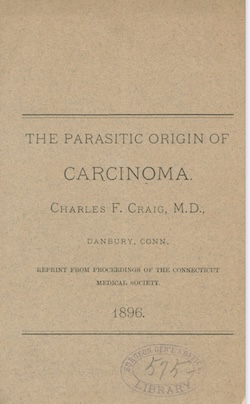
As we sit in the year 2025, revisiting a medical paper from 1896 titled The Parasitic Origin of Carcinoma by Charles F. Craig, M.D., feels like stepping into a time capsule of early scientific inquiry. Shared recently on X , this reprint from the Proceedings of the Connecticut Medical Society has sparked renewed interest, particularly as a growing number of people begin to question conventional approaches to cancer treatment.
https://t.co/FZ0jJI7lua
— Kelly DNP Functional/Integrative Medicine (@kacdnp91) October 24, 2025
Posting again, free download from 1896 ‼️ pic.twitter.com/G52B162r86
While the paper is undeniably dated, its historical context and the resurgence of alternative perspectives warrant a fair and balanced review.
Historical Context and Initial Impression
Published at a time when the germ theory of disease was gaining traction—thanks to breakthroughs in understanding tuberculosis, cholera, and other microbial illnesses—Craig’s work reflects the late 19th-century fascination with parasitic causes of disease. The cover itself, with its aged parchment look and the bold title, evokes a sense of curiosity about a bygone era of medicine. Craig, a physician from Danbury, Connecticut, dives into the hypothesis that carcinoma (a type of cancer) might be linked to parasitic organisms such as psorozoa, coccidia, or even yeast-like bodies. This was a bold proposition, given the limited tools available—microscopes, staining techniques, and early cultivation methods—compared to today’s advanced diagnostics.The paper’s structure is methodical for its time, reviewing prior observations (e.g., Schenerlen’s bacillus findings in 1887) and presenting Craig’s own limited but detailed examinations of cancer tissue sections. He describes various microscopic bodies, stained with fuchsin and methyl blue, which he suspects might be parasitic. Accompanied by hand-drawn illustrations, the work showcases a earnest attempt to correlate these findings with cancer causation, a theory that was both innovative and contentious.
Strengths of the Paper
Craig’s willingness to challenge the prevailing ignorance about cancer’s origins is commendable. His review of international research—spanning Germany, France, and Italy—demonstrates a broad engagement with the scientific community of the era. The detailed descriptions of observed bodies, their shapes, and staining reactions suggest a rigorous, if rudimentary, approach to microscopy. Moreover, his acknowledgment of counterarguments—such as the possibility that these bodies could be degenerating cell nuclei rather than parasites—shows a degree of intellectual honesty rare for the period.
The paper’s relevance today lies in its historical role as a precursor to modern investigations into the microbial links to cancer. While Craig’s specific claims about psorozoa and yeast have not held up, the broader idea that external organisms might influence cancer development has evolved. For instance, we now recognize viruses like HPV (human papillomavirus) and hepatitis B and C as causative agents in certain cancers, validating the parasitic theory in a limited sense. This historical thread makes the document a fascinating artifact for those exploring the evolution of oncology.
Limitations and Outdated Aspects
It is critical to approach this paper with an understanding of how far medical science has progressed. The technology of 1896—lacking electron microscopy, genetic sequencing, or even a clear understanding of cellular metabolism—limited Craig’s ability to definitively prove his hypothesis. Many of the “parasitic” bodies he described were likely misidentified cellular structures or artifacts, a point raised by contemporaries like Cornil and Adler, who attributed them to disintegrating nuclei. The failure to cultivate these organisms consistently or demonstrate spores further undermined the theory at the time.
Modern oncology has largely moved beyond the parasitic origin hypothesis for most cancers, favoring genetic mutations, environmental factors, and metabolic dysregulation as primary causes. Treatments have advanced from speculative inoculations to targeted therapies, immunotherapies, and precision medicine, rendering Craig’s suggestions—such as injecting cultures into animals—obsolete and ethically questionable by today’s standards. The paper’s reliance on anecdotal evidence and the lack of controlled experiments also contrast sharply with the evidence-based medicine we prioritize now.
Relevance in 2025: A Growing Skepticism
Despite its obsolescence, the paper resonates with a contemporary audience skeptical of conventional cancer treatments like chemotherapy and radiation, which often come with significant side effects. The X thread reveals a community intrigued by alternative ideas, with some users citing the use of antiparasitic drugs like ivermectin and mebendazole in cancer management—a notion linked to metabolic similarities between parasites and cancer cells, as noted by Dr. Thomas Seyfried. While this connection is speculative and lacks robust clinical evidence, it echoes Craig’s original curiosity about parasitic influences.The post’s popularity also highlights a desire to revisit historical perspectives, perhaps as a counterbalance to the pharmaceutical-driven model of care. Comments about tribal clinics using antiparasitic protocols and the creation of plant-based medicines suggest a grassroots movement toward integrative approaches. However, skepticism about the paper’s scientific validity is also present, with some users dismissing it as outdated or pseudoscientific—a fair critique given the 130-year gap in knowledge.
Final Verdict
The Parasitic Origin of Carcinoma is a relic of a pioneering yet imperfect era in medical research. It deserves credit for its bold hypothesis and meticulous observations, which contributed to the early dialogue on cancer’s causes. However, its conclusions are largely discredited by modern science, and its practical applications are negligible today. For the historically minded or those questioning current cancer paradigms, it offers a thought-provoking glimpse into the past.
In 2025, modern protocols are exploring the use of antiparasitic medications like ivermectin, fenbendazole, mebendazole, and albendazole in cancer treatment, building on their metabolic similarities to cancer cells. Ivermectin is being studied for its potential to inhibit tumor growth by targeting cancer cell proliferation, while fenbendazole is gaining attention for disrupting glycolysis and enhancing immune responses, as seen in the Ruby Protocol, which combines it with ivermectin, dietary adjustments, and supplements like Vitamin E and curcumin. Mebendazole is researched for blocking hypoxia-induced chemoresistance in breast cancer, and albendazole is evaluated for its antiproliferative effects. Herbal extracts, such as curcumin (anti-inflammatory) and ginger (anti-nausea), are integrated to support these therapies, often tailored to individual needs in integrative clinics. These approaches emphasize immune modulation and personalized plans, alongside advanced supplements, reflecting a holistic shift in cancer care supported by ongoing research and anecdotal success stories.
As these alternative voices grow louder, this paper serves as a reminder of the importance of rigorous testing and evolution in scientific thought.
That link: https://digirepo.nlm.nih.gov/ext/dw/101487214/PDF/101487214.pdf